
 Business License

How to Evaluate a Cremation Equipment Supplier: 10 Decision Factors Beyond Price
A funeral home operator in Eastern Europe received two quotations for a cremation machine within the same week. Supplier A quoted USD 48,000. Supplier B quoted USD 62,000. The operator bought from Supplier A.
Fourteen months later, the machine had accumulated three unplanned downtime events, spare parts took an average of eighteen days to arrive, and no local technician within 300 kilometers could diagnose a recurring PLC fault without remote assistance from the factory — which was available only during a time zone window of four hours per day. The operator later calculated that the "savings" of USD 14,000 had been consumed roughly two and a half times over in lost revenue, emergency freight charges, and extended cold storage costs.
Price is the easiest variable to compare when sourcing cremation equipment. It is also the least informative. What matters over the ten-to-twenty-year operating life of a cremation machine is a bundle of factors that determine whether the equipment runs reliably, complies with evolving regulations, and can be serviced quickly when something breaks.
This article outlines ten decision factors that carry more weight than the bottom-line number on a quotation — and how to assess each one before signing a purchase agreement.
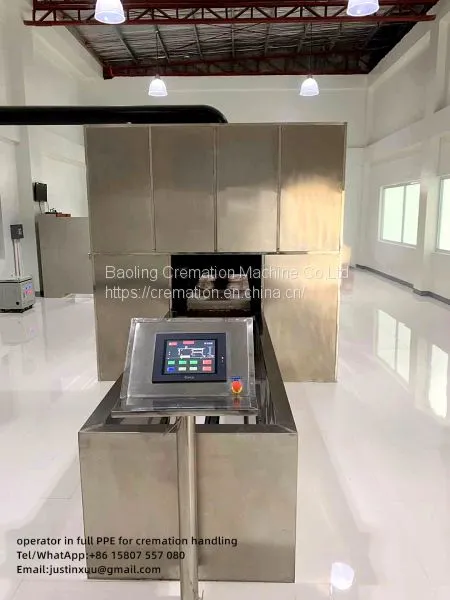
1. Manufacturer Track Record and Production Volume
A supplier that has built and shipped several hundred cremation machines over a decade or more has encountered and solved problems that a low-volume fabricator has never seen — weld fatigue in door hinge assemblies, burner flame instability at high-altitude installations, PLC memory corruption from voltage spikes on weak grids. These are not theoretical risks. They are failure modes documented across thousands of machine-years of operation, engineered out of current designs by suppliers with deep production experience.
Ask for annual production volume and total units in service. A supplier producing fewer than roughly twenty cremation machines per year may lack the production consistency, supply chain stability, and accumulated field data to match the reliability of a higher-volume manufacturer. Ask for references from buyers who took delivery at least three years ago — long enough for latent defects to surface and for the after-sales support relationship to show its true character.
2. After-Sales Support Infrastructure
The most reliable cremation machine in the world will eventually need a spare part or a technician visit. When that happens, the difference between a supplier with regional service partners and one operating exclusively from a single factory location is the difference between roughly two days and roughly two weeks of downtime.
Map the supplier's service network against the buyer's location. A supplier with trained technicians or authorized service partners within the buyer's country or neighboring country can typically respond to a service call within forty-eight to seventy-two hours.
A supplier requiring technician dispatch from the factory, with visa processing and international travel, adds roughly seven to fourteen days to every service event. For a municipal crematorium running at full capacity, fourteen days of downtime on a single machine translates to roughly eighty to one hundred postponed cremations and the logistical and reputational cost of managing that backlog. At Jinjiben Trading, we maintain service partnerships in several regions specifically to keep response times under seventy-two hours for the majority of our installed base.
3. Spare Parts Availability and Lead Times
Burner nozzles, thermocouples, door seal gaskets, PLC power supplies, refractory patch material — these are consumable or wear items that every cremation equipment operator will need within the first three to five years of operation. A supplier that stocks these parts and can ship within forty-eight hours of an order keeps a crematorium running. A supplier that manufactures parts to order after receiving a purchase request keeps a crematorium waiting.
Before signing a purchase agreement, request a spare parts price list with stated lead times for the top fifteen to twenty consumable items. Verify those lead times independently — call the supplier's parts desk with a specific part number and ask when it can ship. The answer from a salesperson during negotiation and the answer from the parts desk on a random Tuesday afternoon often differ by a factor of two or more. We have seen facilities sign contracts based on promised forty-eight-hour parts availability, only to discover after the first breakdown that the actual lead time on critical items stretched to three weeks.
| Critical Spare Part | Typical Replacement Interval | Acceptable Lead Time | Red Flag Lead Time |
|---|---|---|---|
| Burner nozzle assembly | 2–3 years | 3–7 days | >14 days |
| Thermocouple (Type K or S) | 1–2 years | 2–5 days | >10 days |
| Door seal gasket | 1–2 years | 3–7 days | >14 days |
| PLC power supply module | 5–8 years | 3–7 days | >14 days |
| Refractory patch kit | As needed | 3–7 days | >10 days |
| Induced draft fan motor | 5–8 years | 5–10 days | >21 days |
4. Certification Portfolio and Compliance Documentation
A supplier's certification portfolio reveals two things: whether the cremation equipment meets the regulatory requirements of the destination market, and whether the supplier's manufacturing processes are audited by independent third parties. For exports to the EU, CE marking with a valid Declaration of Conformity referencing the applicable directives — typically the Machinery Directive 2006/42/EC and, where relevant, the Pressure Equipment Directive 2014/68/EU — is non-negotiable. For markets referencing ISO standards, ISO 17799 (information security) and SA8000 (social accountability) signal that the supplier's internal processes meet international norms beyond the product itself.
Request copies of all certificates and verify them against the issuing body's online database. A certificate number that cannot be validated online within five minutes is worth exactly nothing. Request the technical file or test reports that support the certification — a supplier that cannot produce these documents within a reasonable timeframe either never had them or lost control of the documentation, both of which are disqualifying for a capital equipment purchase.
5. Reference Site Visits and Operator Interviews
A reference visit to an operating cremation machine that has been in service for at least two years reveals more about a supplier than any sales presentation. Talk to the operator, not the facility manager — the operator knows whether the machine trips on rainy days, whether the PLC interface freezes when two profiles are switched in quick succession, and whether the promised fuel consumption figures match what the gas meter actually records. The facility manager knows the purchase price and the warranty terms. The operator knows whether the machine works.
If an in-person visit is impractical, a video call where the operator walks through the machine, demonstrates a cycle start, and answers questions without the supplier's sales representative present is an acceptable substitute. A supplier that resists connecting a prospective buyer directly with an operator — as opposed to routing all communication through the sales department — is withholding information for a reason.
6. Emission Compliance Beyond the Specification Sheet
Every cremation equipment quotation includes emission figures. Few include the test conditions under which those figures were measured — the fuel type, the coffin material, the ambient temperature, and whether the numbers represent steady-state operation or include the transient peaks that occur during door opening and cold starts. Emission figures measured under optimal conditions with a lightweight coffin and the burner running at 85% modulation tell you almost nothing about real-world performance with an oversized hardwood casket and the door opening twice during the cycle.
Ask for emission test reports from third-party stack testing at an operating facility — not factory acceptance test data. Ask whether the figures include cold-start transients and door-open events. If the supplier cannot produce this data, assume the quoted emission figures represent best-case laboratory conditions and apply a conservative degradation factor of roughly 20% to 30% when comparing against local regulatory limits.
7. Contract Terms: Warranty Scope, Exclusions, and Performance Guarantees
A standard warranty on cremation equipment typically covers manufacturing defects for twelve to twenty-four months. Read the exclusions as carefully as the coverage. Common exclusions that surprise buyers after the fact include: refractory lining (treated as a consumable, not a warranted component), damage from voltage fluctuations (even when the machine was sold into a region with known grid instability), and consequential damages (the supplier replaces the failed part but bears no responsibility for the revenue lost during downtime).
Negotiate warranty terms that reflect the operating conditions of the installation site. If the local grid voltage fluctuates by ±15%, the warranty should cover electrical component failures caused by those fluctuations, and the quotation should include voltage stabilization equipment priced into the package. If the machine will fire coffins larger than the standard dimensions the supplier designed around, get written confirmation that the warranty covers operation with those coffin sizes.
8. Training and Documentation Quality
A cremation machine delivered with a poorly translated manual and no on-site operator training will underperform regardless of its mechanical quality. Evaluate the supplier's training program before the purchase, not after the installation. Request a copy of the operator manual in the language the operators will use. Read the troubleshooting section — if it lists error codes with vague descriptions ("System Fault — Contact Supplier"), the supplier's support philosophy is reactive rather than preventive.
On-site training should cover at minimum: normal cycle operation, emergency shutdown procedures, daily and weekly maintenance tasks, PLC profile modification, and basic fault diagnosis. Training delivered by the commissioning engineer during the installation week is standard; training delivered by a dedicated trainer who stays for three to five days of supervised operation is better. Hunan Jinjiben Trading Co Ltd includes operator training as a standard line item in every cremation equipment package, with trainers staying on site until the operators can run three consecutive cycles without supervision.
9. Financial Stability and Business Longevity
A cremation machine is a fifteen-to-twenty-year asset. The supplier that built it should still exist in fifteen to twenty years, or at minimum, the critical spare parts and technical documentation should remain accessible through a successor entity or an independent parts network built around standardized components. A supplier operating from rented premises with fewer than ten employees and a corporate history of less than five years represents a higher risk of disappearing — taking proprietary PLC software keys, casting patterns, and specialized tooling with it.
Check the supplier's corporate registration, years in business, and any public financial filings. A supplier that has weathered at least one economic downturn — 2020, for example — without folding has demonstrated a baseline level of financial resilience. For suppliers using proprietary control systems, ask what happens to the software licenses and diagnostic tools if the company ceases operations. A credible answer involves an escrow arrangement or a commitment to release source code and documentation to the buyer under specified conditions.
10. Cultural and Communication Compatibility
The relationship between a cremation equipment buyer and supplier spans years, not weeks. During that time, the two parties will negotiate change orders, resolve warranty claims, and coordinate complex international logistics. Cultural friction — different expectations about response times, different norms around contract interpretation, different communication styles — can turn a technically sound supplier relationship into a constant source of frustration.
Evaluate how the supplier communicates during the quotation phase. Do they answer technical questions with specifics or with marketing language? Do they acknowledge when they do not know something and commit to finding out, or do they deflect? Do response times lengthen noticeably after the quotation is submitted?
These patterns during the courtship phase reliably predict behavior during the marriage. A supplier that communicates clearly, admits knowledge gaps, and maintains consistent response times throughout the sales process will likely do the same during warranty service and beyond. Jinjiben has found that the clearest predictor of a smooth installation is not the technical specification of the equipment but the quality of communication during the six to eight weeks of pre-shipment coordination.
11. Frequently Asked Questions About Cremation Equipment Supplier Evaluation
11.1 Should I always choose the supplier with the lowest price?
Almost never. The purchase price of cremation equipment represents roughly 25% to 35% of the total cost of ownership over a fifteen-year operating life. Fuel, maintenance, spare parts, and downtime collectively account for the remaining 65% to 75%. A machine that costs 20% less to buy but consumes 30% more fuel and experiences twice the downtime will cost more in total than the higher-priced alternative within roughly three to five years of operation.
11.2 How many suppliers should I get quotations from?
Three to five is the practical range. Fewer than three limits competitive pressure on pricing and does not provide enough contrast to evaluate supplier quality. More than five becomes administratively burdensome and dilutes the depth of evaluation you can apply to each candidate. The goal is not to collect the most quotations — it is to collect enough to make a confident decision.
11.3 Can I trust online reviews and testimonials for cremation equipment suppliers?
Online reviews on B2B platforms can be a starting point, but they should never be the endpoint. Verified transaction records showing repeat purchases from the same buyer carry more weight than anonymous five-star ratings. Direct reference calls with buyers who purchased similar equipment at least two years ago are the gold standard. If a supplier cannot provide three such references, treat that absence as a data point in your evaluation.
Recently Posted
-
Hunan Jinjiben Trading Co., Ltd.: Your Partner for Cremation Equipment Sourcing from China
August 14, 2026When a funeral industry buyer begins searching for cremation equipment from China, the landscape can feel overwhelming. Hundreds o Read More
 -
Cremation Equipment for Municipal Crematoriums: High-Volume Solutions for Urban Population Centers
August 13, 2026A municipal crematorium in a Southeast Asian city of roughly two million people found itself operating at 130% of its design capac Read More
 -
Refractory Brick Grades for Cremation Furnaces: Silicon Carbide vs. High Alumina vs. Mullite
August 11, 2026A crematorium in South America replaced its primary chamber refractory lining with what the supplier called "standard furnace
Read More -
What Defines a Modern Cremation System: Core Components and Operational Parameters Explained
August 10, 2026Not long ago, a funeral home operator in Eastern Europe took delivery of what the invoice called a "complete cremation system Read More

Contact Us
Recommended Products
-
 Human Cremation Machine Electric Crematorium Machine With 100kg/H Capacity and 18kw Power Crematory EquipmentNegotiableMOQ: 1 Piece
 -
220V/380V Full Automatic Human Crematorium Cremation Machine New Crematory Furnace 18kW Power PLCNegotiableMOQ: 1 Piece
-
New Full Automatic Human Crematory Incinerator Oven No Smoke Cremation Machine Crematory Equipment Crematorium MachineNegotiableMOQ: 1 Set
-
Electric Human Crematorium Machine Full Automatic Cremation Incinerator Indonesia Extra Large Coffin Cremation Electric Human Crematory MachineNegotiableMOQ: 1 Piece
-
Extra Large Coffin Cremation Machine New Technology Human Crematorium Furnace Full Automatic 100kg/h 5-Year WarrantyNegotiableMOQ: 1 Set
-
Human Cremation Machine for Sale Full Automatic Model USA TypeNegotiableMOQ: 1 Set
-
220V/380V Full Automatic Human Crematorium Cremation Machine Crematory Furnace 18kW Power PLC ControlNegotiableMOQ: 1 Set
-
Automatic Human Cremation Machine No Smell No Smoke Latest Human Cremation Technology 50/60HZ Diesel LPG CremationNegotiableMOQ: 1 Set
-
Automatic Human Crematorium Incinerator Crematory Furnace Human Cremation Machine for Wood Coffin CremationUS$ 66000MOQ: 1 Set
-
Electric Human Crematory Machine Cremation Machine No Smoke Crematorium Incinerator Cremation EquipmentUS$ 55000MOQ: 1 Combo
-
220V/380V Full Automatic Human Crematorium Cremation Machine New Crematory Furnace 18kW Power PLC Core Refractory Material 1NegotiableMOQ: 1 Set
-
Cremation Machine Burn Human Body Electrical Crematorium Machine Cremator Crematoria Europe StandardUS$ 5MOQ: 1 Set
-
Cremation System Cremation Oven Fired by Natural Gas no Smoke Human Crematorium Incinerator Crematory EquipmentNegotiableMOQ: 1 Piece
-
Cremation Equipment for Sale Eu Standard Environmental Friendly no Smoke Quick Burning Fast Short Time Cremation Machine No SmellUS$ 1 - 10MOQ: 1 Set
-
Crematorium Oven Machine Container Burn Human Body Mobile Furnace for Sale Crematory Incinerator Cremation Machine Crematory EquipmentUS$ 1 - 10MOQ: 1 Set
-
Container Crematory System Burn Human Death Body Crematoria Emergency Human Cremation Machine Crematorium IncineratorUS$ 1 - 10MOQ: 1 Set
-
Cremation Machine for Australia Market no Smell Human Crematory Machine Automatic Loading Conveyor Cremation EquipmentNegotiableMOQ: 1 Set
-
Global Top Supplier of Crematory Equipment Human Cremators Crematory Equipment Cremation Unit no Smell no SmokeNegotiableMOQ: 1 Kilogram
-
Cremation Machine Human Crematory Burner Equipment Furnace on Wheels Cremation Machine no Smoke USA StandardUS$ 1 - 10MOQ: 1 Piece
-
Automatic Cremation Machine Crematory Equipment for Human Crematorium Equipment Europe Standard EmissionUS$ 1 - 10MOQ: 1 Piece